

Odoo app guide
Odoo Helpdesk: Support Requests & Accountable Resolution
Odoo Helpdesk gives support teams a shared process for handling customer requests as tickets. A useful setup defines intake, ownership, escalation and the evidence of resolution, with connected service workflows where needed. Ever Digital helps configure that process. Service entitlement, external monitoring, specialized SLA rules and third-party communication channels must be verified against the exact requirements.
Official Odoo Partner · Ever Digital
Make a request understandable before it reaches a technician.
The initial record should identify the customer, affected service or site, reported symptom and a usable contact route. Agree which channels create tickets and how duplicates are recognized. A customer who calls and emails about the same fault should not unknowingly create two independent service obligations.
Decide how urgency is assessed. A customer’s preferred priority and the business’s response commitment may differ. Support staff need clear criteria and an escalation route rather than an unexplained priority label.
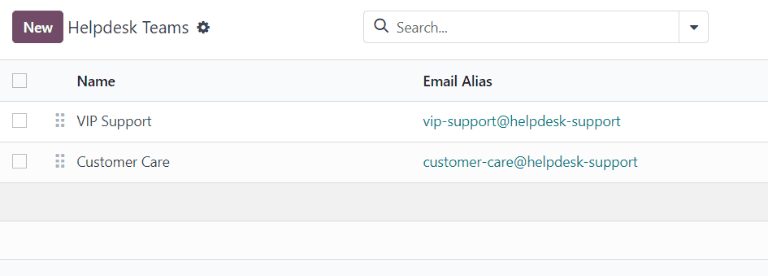
Odoo documentation · CC BY-SA 4.0 · CC BY-SA 4.0
Original documentation image, shown without altering the interface. The screenshot illustrates standard Odoo, not a customer implementation.
Use stages that explain what is preventing resolution.
The team should be able to distinguish its own next action from a dependency on the customer or another department.
| Situation | Required ownership | Useful evidence |
|---|---|---|
| New request | An assigned team or person reviews the report. | The affected service and initial next action are understood. |
| Investigation | A responsible person coordinates diagnosis. | Findings and the next test are recorded without unnecessary sensitive information. |
| External dependency | Someone owns follow-up with the customer, supplier or field team. | The reason for waiting and expected next review are visible. |
| Resolution | An accountable reviewer confirms the outcome. | The remedy, remaining limitations and customer communication are recorded. |
A ticket may require work in another app.
Some requests are resolved remotely. Others need a field visit, replacement stock, a quotation or a project change. Define the handoff and the link back to the support request. Creating a second record should not remove ownership of the customer’s original problem.
For a chargeable visit, determine how the customer authorizes the work before dispatch. For a covered visit, identify the contract evidence and any allowance consumed. Neither a customer name nor a previous invoice is sufficient proof that every requested service is included.
Agree what response and resolution measures actually mean.
If the business uses service-level targets, define the relevant calendar, start and stop conditions, priorities and exceptions. Demonstrate the required behavior in the selected configuration. A report is only useful when everyone understands whether it measures first response, restoration or final closure.
Avoid advertising universal SLA enforcement from a generic ticket workflow. Complex contracts, exclusions, customer-specific allowances and monitoring-triggered incidents may need additional design or development. The requirement should be tested using the difficult case, not just a ticket closed within the target.
Keep support information proportionate and controlled.
A support record can contain sensitive operational details. Configure access and collection practices deliberately.
- Do not store passwords, private keys or unnecessary customer credentials in ordinary ticket notes.
- Choose the information customers may see through any enabled portal and test it with the correct role.
- Verify integrations with email, messaging, remote monitoring or external service systems.
- Define retention and attachment handling according to the business’s actual obligations.
Test a reopened issue and a field escalation.
Use one request resolved remotely, one needing a site visit and one reopened after an apparent resolution. Confirm that staff can follow the history, understand responsibility and avoid duplicate billing or dispatch. A closure count alone will not reveal these process gaps.
Bring a typical support email, an escalation example and a service agreement to an Ever Digital assessment. We can map the intake and handoff process, identify configuration needs and separate standard ticket management from the specialist controls your contracts require.
Questions businesses ask
Can a ticket create a field service task?
Odoo documents a Helpdesk-to-Field-Service workflow when configured with the relevant apps. Test the task creation, ownership and link to the original request.
Does Helpdesk replace network monitoring?
No. Monitoring and remote management tools perform different functions. Any connection that creates or updates tickets needs a defined integration and duplicate-handling process.
Are support contracts automatically enforced?
Do not assume that. Coverage, exclusions, allowances and billing rules need a specific design and acceptance test.
What should be measured after rollout?
Use measures whose definitions the team agrees on, such as response, resolution, reopened issues and unresolved dependencies. Review data quality before treating them as contractual evidence.
Sources and factual scope
Capabilities checked against official Odoo documentation. These are planning examples, not promises that every feature is included in a Starter package.
Reviewed:
Ever Digital
Bring your real workflow to the conversation.
Tell us how you sell, stock, deliver or service. We will identify the standard apps, decisions and any extensions your implementation needs.
View Starter packages Current implementation fees and included scope are maintained on the Starter package pages. Odoo licences, hosting and custom work are separate.