

Industry blueprint
Odoo ERP for IT & Network Companies in Iraq
Odoo can connect an IT company’s opportunities, quotations, hardware procurement, project tasks, support requests and accounting. The configuration should distinguish product resale, project delivery and ongoing managed services, because each uses different work and billing rules. Ever Digital maps those processes and their shared customer data. Remote monitoring, endpoint management, credential storage, software licence automation, service entitlements and specialist integrations require their own verified scope.
Official Odoo Partner · Ever Digital
The first operational handoffs
- 01Qualify the requirement
- 02Confirm the commercial model
- 03Prepare delivery
Hardware, projects and managed services should share records without losing their differences.
An IT company may sell a server, deploy a network and provide ongoing support to the same customer. The hardware sale changes stock, the project creates work commitments and the support agreement creates continuing service obligations. Entering all three as a generic sales line makes it difficult to explain what was delivered, what remains open and what should be invoiced.
Start with the business models you operate. Decide how an opportunity becomes a quotation, how confirmed work creates tasks and how a support request finds the relevant customer and agreement context. Odoo can connect those records, while technical management systems may continue to operate alongside it.
Ever Digital · Odoo
Your Odoo industry blueprint
Follow the work from the first request to the operational result. Each stage shows the Odoo app and the configuration decision behind it.
- 01
Qualify the requirement
- Odoo app
- CRM
- Configuration decision
- Customer goals, technical inputs and scope owner.
- Operational outcome
- The proposal begins with a clear requirement.
- 02
Confirm the commercial model
- Odoo app
- Sales
- Configuration decision
- Resale, project, time/materials or managed service.
- Operational outcome
- The accepted offer defines the billing basis.
- 03
Prepare delivery
- Odoo app
- Purchase + Project
- Configuration decision
- Equipment, dependencies and assigned responsibilities.
- Operational outcome
- The team has a credible delivery plan.
- 04
Complete project or site work
- Odoo app
- Project + Field Service
- Configuration decision
- Tasks, time, materials and acceptance evidence.
- Operational outcome
- Work is recorded against the commitment.
- 05
Support the customer
- Odoo app
- Helpdesk
- Configuration decision
- Agreement context, escalation and follow-up.
- Operational outcome
- Issues move through an accountable resolution path.
- 06
Review and invoice
- Odoo app
- Sales + Accounting
- Configuration decision
- Approved charges, recurring scope and reconciliation.
- Operational outcome
- Billing reflects the agreed service model.
Choose the commercial and operational record for each service.
The useful app mix follows the work. It should not be driven by a desire to activate every available application.
| IT business activity | Odoo starting point | Boundary to review |
|---|---|---|
| Hardware and software resale | Sales, Purchase, Inventory where stock exists, and Accounting. | Licence provisioning, renewals and vendor portals may require additional design. |
| Implementation project | Sales connected to Project and the agreed billing policy. | Acceptance, scope changes and specialized technical documentation. |
| On-site network installation | Project or Field Service with equipment/material movements. | Site readiness, technical testing and qualified handover. |
| Managed IT service | Helpdesk, work tracking and a defined agreement/billing design. | Entitlements, seat counts, usage charges, RMM and PSA integrations. |
Turn discovery into an accepted scope that the delivery team can use.
CRM can organize opportunities and technical clarification. Sales should preserve the accepted equipment, services, assumptions and commercial terms. A project handoff needs more than a quotation total: the delivery team should know the work boundaries, dependencies, customer responsibilities and acceptance point.
A customer may add users, locations or technical requirements after confirmation. Define how changes are assessed and approved before they become unplanned work. For fixed-price projects, this distinction is essential to understanding whether the team is completing the original scope or delivering an additional commitment.
Recommended Odoo apps
| Odoo app | Why this app | Example in your business | Scope |
|---|---|---|---|
| CRM | Coordinate opportunities and discovery before a proposal is accepted. | Track a network project through technical clarification. | Custom or optional |
| Sales | Record hardware, project and service commitments. | Separate equipment resale from fixed-price implementation services. | Standard Odoo |
| Project | Organize delivery tasks, responsibilities and recorded effort. | Track deployment stages and a customer-approved scope change. | Standard Odoo |
| Helpdesk | Manage support requests and escalation ownership. | Qualify an issue that needs a field visit or additional project work. | Standard Odoo |
| Purchase | Source hardware or other supplier-provided items. | Order the approved network equipment using supplier references. | Custom or optional |
| Inventory | Record physical equipment movements where stock exists. | Trace a delivered device and unused installation materials. | Custom or optional |
| Field Service | Manage assigned customer-site work. | Schedule a network installation or corrective visit. | Custom or optional |
| Accounting | Connect the billing model to invoices and payments. | Reconcile a hardware invoice and an approved time-and-materials service. | Standard Odoo |
Availability depends on the Odoo edition, hosting and subscription. Configuration, data migration and training are implementation work. Specialist connectors and extensions require a separate scope.
Keep hardware procurement connected to project readiness.
A network installation may depend on switches, access points, racks, cabling and other equipment. Purchase and Inventory can record procurement and stock movements, with serial tracking where required. Maintain supplier references and approved product specifications so the buyer and technician refer to the same item.
A project date should be reviewed against actual readiness, including equipment, access, customer dependencies and personnel. Test partial receipts, an approved alternative and materials returned unused. Software licences and cloud subscriptions may have no physical stock movement; their provisioning and commercial records require a different model from boxed hardware.
Odoo documentation · CC BY-SA 4.0 · CC BY-SA 4.0
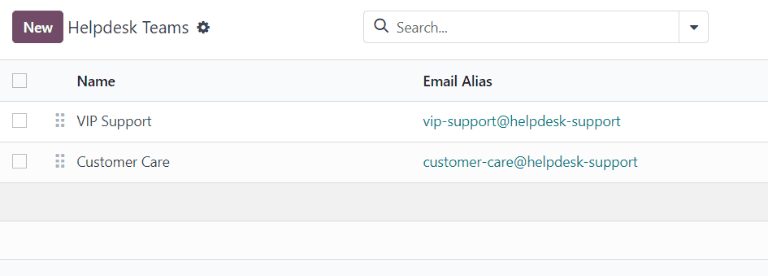
Original documentation image, shown without altering the interface. The screenshot illustrates standard Odoo, not a customer implementation.
Network installation companies: define work packages and handover evidence.
Project can organize cabling, equipment installation, configuration, testing and customer handover as separate responsibilities where appropriate. Field Service can support assigned site visits. Decide what technicians record and who reviews the result before the customer is asked to accept the work.
Network design, performance testing, device configuration and certification remain specialist technical activities. Odoo can preserve the relevant approved records, but it does not automatically replace engineering tools, controller software or testing instruments. As-built diagrams, configuration backups and sensitive credentials need an appropriate storage and access process.
Managed IT service providers: separate recurring revenue from service entitlement.
A managed-service agreement may cover particular users, devices, sites, hours or types of support. The team needs to know what is included when a request arrives, not only when a recurring invoice is generated. Define how the agreement changes when the customer adds devices or requests work outside coverage.
Helpdesk can organize tickets and responsibility, while time tracking can support effort review. Seat-based billing, usage charges, prepaid hours, service-level commitments and automated renewal rules require explicit assessment. Recurring invoicing alone does not establish a complete professional-services automation platform or enforce every contract entitlement.
Give a support request a clear resolution path.
An issue may be resolved remotely, require a site visit, become a project or lead to replacement equipment. Agree how the ticket is qualified and which event creates the next work record. Avoid creating unrelated tasks that force the customer to repeat the same information to each team.
The support record should explain the work performed, time or products used where relevant and unresolved follow-up. Remote monitoring, endpoint management, backup systems and alert ingestion are separate integrations with their own access and failure handling. Odoo Helpdesk does not become an RMM platform simply because it receives a notification.
Match the invoice to the work the customer agreed to buy.
Hardware delivery, fixed-price implementation, time and materials, and managed-service fees need different commercial treatment. Sales and Accounting should reflect the agreed policy, while tasks and time records provide supporting evidence. Decide who reviews billable time and approves additional charges.
Project profitability depends on the inputs the business actually records. If management needs hardware cost, employee time, subcontracting and licence charges in one view, define that report and its data sources. For Iraq operations, finance should also agree company currency, transaction currencies, rate ownership and reconciliation. Local statutory reports and payment integrations are separately verified.
Keep operational access separate from sensitive technical access.
The ERP may contain commercial and service information, but not every staff member needs access to every customer’s technical environment.
- Define roles for sales, project delivery, support, purchasing and finance.
- Use an appropriate controlled system for credentials and secrets rather than broadly visible task notes.
- Agree which customer/site/device references are needed in Odoo and which technical records remain in specialist systems.
- For each integration, establish data ownership, service credentials, error reporting and duplicate prevention.
- Test permissions with the actual roles used by the team, including customer-facing access if a portal is in scope.
Pilot one customer across resale, project delivery and support.
A connected example helps reveal missing handoffs between teams that otherwise appear to work well in isolation.
- Clean customer and site records, product references, supplier mappings and required equipment identifiers.
- Agree the treatment of open opportunities, projects, tickets, agreements and unpaid invoices at cutover.
- Test a hardware purchase, partial delivery, project task, scope change and customer acceptance.
- Create a support request that needs a field visit or additional quotation and verify the handoff.
- Reconcile time, stock, contract context and invoices before adding more service models.
Build a business-management foundation around your technical tools.
Ever Digital can assess the Odoo commercial and operational workflow and the integrations needed with the systems your IT team already uses. The first release should cover a complete service cycle with defined owners, while specialist automation follows a reviewed interface and acceptance plan.
Bring a project quotation, work record, support ticket and managed-service agreement with sensitive details removed. Current package pages provide standard fees and inclusions. RMM connections, licence automation, complex entitlements and migration effort are scoped against the actual requirement, with training for each operating role.
Questions businesses ask
Can Odoo replace our remote monitoring and management tools?
No general replacement is promised. Odoo can manage commercial and service records, while RMM, endpoint, backup and monitoring systems remain specialist tools or separately assessed integrations.
Can one company sell hardware and provide managed services?
Yes. The implementation should distinguish physical delivery, project work and ongoing service obligations while sharing the relevant customer and finance records.
Does recurring invoicing include full managed-service entitlement tracking?
Not automatically. Covered users or devices, prepaid hours, exclusions, usage charges and service commitments need explicit design and testing against the agreement.
Can we bill project time and materials?
Odoo documents time-and-materials invoicing. The service products, time entries, product use, approval process and invoice result must be configured and tested together.
Can a support request become an on-site job?
A Helpdesk-to-Field-Service workflow can be configured. The team should define authorization, transferred information and how the ticket and task are resolved without losing context.
What should an IT company prepare for migration?
Prioritize clean customers, sites, equipment references, open projects and tickets, active agreements and financial balances. Keep sensitive credentials in an appropriate controlled system and define the integration boundaries.
Sources and factual scope
Capabilities checked against official Odoo documentation. These are planning examples, not promises that every feature is included in a Starter package.
- Odoo CRM documentation
- Odoo Project documentation
- Odoo Helpdesk documentation
- Odoo: field-service task creation
- Odoo: time-and-materials invoicing
- Odoo: milestone invoicing
Reviewed:
Ever Digital
Bring your real workflow to the conversation.
Tell us how you sell, stock, deliver or service. We will identify the standard apps, decisions and any extensions your implementation needs.
View Starter packages Current implementation fees and included scope are maintained on the Starter package pages. Odoo licences, hosting and custom work are separate.