

Industry blueprint
Odoo ERP for Generator & UPS Companies in Iraq
Odoo can connect generator and UPS equipment sales with purchasing, serial-tracked stock, installation tasks, service visits and accounting. A useful setup preserves equipment identity and distinguishes delivery, commissioning, maintenance and chargeable repairs. Ever Digital configures those commercial and operational handoffs. Runtime-based service triggers, telemetry, load testing, engineering certification, battery analytics and specialist warranty or contract rules require separate verification.
Official Odoo Partner · Ever Digital

The first operational handoffs
- 01Confirm the equipment requirement
- 02Procure and record the unit
- 03Deliver and install
Keep equipment identity connected through supply and service.
A generator or UPS customer may first buy equipment and later request installation, maintenance, replacement components or fault diagnosis. The sales team, warehouse and service team need different information, but they should be referring to the same customer, site and equipment. A product name alone may be insufficient when several units of the same model are in use.
Define the identifiers required at procurement, receipt, delivery and service. Serial tracking can support physical traceability, while customer asset history and service entitlement may need additional configuration. Agree how replacement equipment or a relocated unit changes those records so the next technician can find the right context.
Ever Digital · Odoo
Your Odoo industry blueprint
Follow the work from the first request to the operational result. Each stage shows the Odoo app and the configuration decision behind it.
- 01
Confirm the equipment requirement
- Odoo app
- Sales or CRM
- Configuration decision
- Approved specification and customer/site context.
- Operational outcome
- The offer identifies the intended equipment and work.
- 02
Procure and record the unit
- Odoo app
- Purchase + Inventory
- Configuration decision
- Supplier references, quantities and serial capture.
- Operational outcome
- Received equipment has a dependable identity.
- 03
Deliver and install
- Odoo app
- Inventory + Field Service
- Configuration decision
- Stock release, readiness and site-task responsibility.
- Operational outcome
- Delivery and installation remain distinct records.
- 04
Review acceptance
- Odoo app
- Project or Field Service
- Configuration decision
- Qualified technical evidence and handover ownership.
- Operational outcome
- The service scope has a clear completion point.
- 05
Handle maintenance
- Odoo app
- Helpdesk + Field Service
- Configuration decision
- Request or verified planned trigger, diagnosis and approval.
- Operational outcome
- Later work refers to the right customer equipment.
- 06
Reconcile and invoice
- Odoo app
- Accounting
- Configuration decision
- Agreement coverage, parts, time and approved charges.
- Operational outcome
- The commercial result follows the work authorized.
Separate the equipment transaction from the work around it.
Power-equipment businesses often combine trading and service. The configuration must reflect which event changes stock, which completes work and which permits billing.
| Activity | Odoo foundation | Decision to validate |
|---|---|---|
| Equipment supply | Sales, Purchase, Inventory and Accounting. | Model/serial identity, delivery and invoice policy. |
| Installation or commissioning support | Project or Field Service linked to the commercial scope. | Site readiness, qualified acceptance and completion evidence. |
| Reactive maintenance | Helpdesk and a reviewed field-service handoff. | Diagnosis, authorization, parts and extra charges. |
| Planned maintenance agreement | A defined contract and scheduling design. | Coverage, visit triggers, exclusions and escalation. |
Preserve the accepted equipment specification.
An enquiry may depend on the customer’s application, technical requirements and site conditions. CRM can organize clarification, while Sales records the accepted equipment and service scope. Product references and variants should distinguish actual sellable configurations without making the catalogue unnecessarily complex.
Electrical sizing, load assessment, operating suitability and technical certification are specialist decisions. Odoo is not presented as the engineering tool that makes them. If an approved technical document supports the quotation, decide how its revision and acceptance are recorded and made available to purchasing and service teams.
Recommended Odoo apps
| Odoo app | Why this app | Example in your business | Scope |
|---|---|---|---|
| Sales | Record equipment and service commitments. | Quote a UPS unit and separately defined installation work. | Standard Odoo |
| Purchase | Source equipment and service parts. | Order the approved model and record a supplier shortage. | Standard Odoo |
| Inventory | Track units, serials and service material movements. | Trace a delivered generator and reconcile parts issued to a later job. | Standard Odoo |
| Field Service | Organize customer-site installation and maintenance tasks. | Assign a fault visit with equipment context and work authorization. | Standard Odoo |
| Helpdesk | Manage service requests and escalation ownership. | Qualify a reported failure before arranging the field task. | Custom or optional |
| Project | Coordinate larger installation stages where needed. | Track readiness, installation and acceptance as separate responsibilities. | Custom or optional |
| Accounting | Connect equipment and service invoices with finance review. | Reconcile a fixed-price installation and an approved additional repair. | Standard Odoo |
Availability depends on the Odoo edition, hosting and subscription. Configuration, data migration and training are implementation work. Specialist connectors and extensions require a separate scope.
Track the intended unit and the materials needed to deliver it.
Purchase can manage supplier offers and orders, with Inventory recording actual receipts and device identity. Maintain supplier references and lead times for equipment and service parts. A partial shipment or proposed model substitution should have a clear commercial and technical decision owner.
Define locations for saleable equipment, customer returns and items awaiting inspection where needed. The dispatch process should identify the unit released and the destination. Installation materials, spare batteries and service components require their own unit and stock rules; a single equipment delivery does not explain every later material movement.
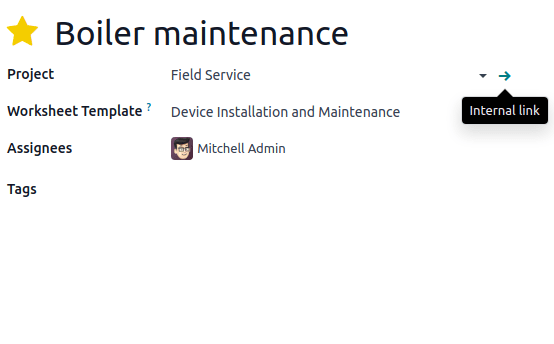
Odoo documentation · CC BY-SA 4.0 · CC BY-SA 4.0
Original documentation image, shown without altering the interface. The screenshot illustrates standard Odoo, not a customer implementation.
Generator maintenance companies: agree what triggers a visit.
Maintenance may be planned by calendar, reported running hours, a customer request or an external monitoring event. These triggers require different data and automation. Define who reads or supplies the runtime information, how it is validated and what happens when a reading is missing or inconsistent.
Field tasks can record the service work, time and materials under the configured process. Runtime-driven scheduling, telemetry ingestion, fuel monitoring and diagnostic integrations must be assessed separately. A calendar task does not automatically implement a complete generator maintenance program or prove that the required technical checks were performed.
UPS companies: distinguish equipment service from battery management requirements.
A UPS service visit may concern the unit, batteries or associated equipment. The task should identify what is being inspected or replaced and the evidence needed for review. Decide which components have individual identifiers and how a replacement is connected to the customer’s equipment history.
Battery condition analysis, test instruments, specialist maintenance calculations and disposal or compliance records are not assumed to be standard ERP features. Define the required workflow with the responsible specialists. Odoo can support commercial and operational records while the technical measurements and decisions remain in appropriate tools and qualified processes.
Make diagnosis and extra-work approval visible.
A fault call can reveal parts or work outside the original request. The technician should record the finding and proposed action, while the agreed approval process determines whether work proceeds. A customer may authorize temporary restoration but postpone a larger replacement.
Helpdesk can organize the enquiry and Field Service can manage the site task. Decide how follow-up work remains open and how the customer is informed. Service agreements, warranty eligibility, manufacturer recovery and enforced approval rules need a defined scope; serial tracking and a task status alone do not provide them.
Reconcile stock, effort and the commercial agreement.
A job may use stocked parts, a component ordered specifically for the customer and unused materials returned after the visit. Record the movement and charging rule for each. Time-and-materials invoicing requires the configured service products, time records, product use and review process to work together.
Fixed-price installation, included maintenance and separately approved repairs need different invoice treatment. Finance should test the resulting documents and payments. For Iraq operations buying in foreign currencies, agree company currency, exchange rates, valuation and acquisition-cost treatment. Local statutory reporting and payment-provider connections are assessed separately.
Configuration decisions for power-equipment supply and service.
Use actual equipment and service scenarios to decide which records and controls are necessary.
- Equipment identity: model references, supplier codes, serials and the required customer/site relationship.
- Stock: receipts, dispatch, service components, restricted items and unused-material returns.
- Service: intake, diagnosis, authorization, task stages and technical review responsibility.
- Planned work: calendar, runtime or external triggers, with the required data source and exception handling.
- Finance: equipment and service billing, agreement coverage, extra charges and reconciliation.
- Field environment: actual devices, network conditions, role permissions and working-language training.
Test a sale, installation and later fault as one connected example.
A lifecycle pilot shows whether the team can find and act on the equipment information after the first invoice has been issued.
- Clean customers, sites, equipment references, suppliers and required serial lists.
- Agree the cutover treatment of delivered equipment, open installations, maintenance commitments and outstanding invoices.
- Test a partial receipt, unit delivery, installation task and the intended acceptance point.
- Create a later fault request, approve extra work, record a replacement part and return unused stock.
- Reconcile the task, stock and financial result before expanding to all service teams.
Scope the technical interfaces separately from the ERP foundation.
Ever Digital can map the sales-to-service cycle and assess the required app mix, data migration and training. Provide sample equipment documents, service sheets and invoices, plus details of any monitoring or test systems that must connect. Their interfaces and reliability need verification before an integration is promised.
Current package pages describe standard fees and inclusions. Runtime automation, telemetry, complex asset history and maintenance entitlements can change the scope and should receive explicit acceptance criteria. A staged release should still demonstrate a complete ordinary cycle and the most important exceptions.
Questions businesses ask
Can Odoo track generators and UPS units by serial number?
Odoo supports serial tracking in Inventory. The required customer/site and service-history relationship should also be scoped and tested; serial movements alone do not establish a complete asset-service register.
Can maintenance be triggered by running hours?
Runtime-based scheduling needs a verified data source, trigger logic and exception process. It is assessed separately from ordinary calendar planning, especially when readings come from telemetry or external devices.
Does Odoo perform generator load testing or battery analysis?
No specialist technical-testing capability is promised here. The ERP can support work records and commercial processes, while measurements and engineering decisions require appropriate tools and qualified responsibility.
Can a technician charge extra parts during a repair?
The business must define authorization and billing rules. Odoo has documented time-and-materials workflows, but service products, product use, approvals and the invoice result should be tested together.
Are manufacturer warranty claims included?
Warranty eligibility, evidence, approvals and manufacturer recovery depend on specific terms and systems. They need their own workflow assessment rather than being assumed from serial tracking.
What should we include in a pilot?
Use an equipment sale, installation, later fault call, approved extra work and replacement part. Verify that customer/equipment context, stock, time and invoices remain connected across the cycle.
Sources and factual scope
Capabilities checked against official Odoo documentation. These are planning examples, not promises that every feature is included in a Starter package.
- Odoo: serial-number tracking
- Odoo: field-service tasks
- Odoo: field-service products
- Odoo: worksheets and Studio
- Odoo: time-and-materials invoicing
- Odoo Maintenance documentation
Reviewed:
Ever Digital
Bring your real workflow to the conversation.
Tell us how you sell, stock, deliver or service. We will identify the standard apps, decisions and any extensions your implementation needs.
View Starter packages Current implementation fees and included scope are maintained on the Starter package pages. Odoo licences, hosting and custom work are separate.