

Industry blueprint
Odoo ERP for Electronics Distributors in Iraq
Odoo provides a connected base for electronics distributors to manage dealer quotations, sales orders, supplier purchasing, stock movements and accounting. Serial tracking and customer pricelists support common requirements, but successful implementation depends on allocation, product identity, import-cost treatment and return decisions. Ever Digital scopes those operational rules for your distribution business. Manufacturer claims, rebate calculations, warranty portals and external dealer integrations require separate verification.
Official Odoo Partner · Ever Digital
- Sales
- Purchase
- Inventory
- Accounting
The difficult decision is often who receives the next shipment.
An electronics distributor may have several dealers waiting for the same incoming model. A shipment may arrive short, a customer may change its configuration and a salesperson may have promised stock before the goods were received. A warehouse balance alone cannot explain those competing commitments.
The implementation should make the allocation process explicit. Who can reserve stock? Which orders take priority? How are a partial shipment and a customer cancellation handled? Odoo connects sales, procurement and inventory documents; the business must decide the policy that those documents support. Any enforced approval or allocation algorithm should be demonstrated rather than inferred from the presence of a reservation field.
Ever Digital · Odoo
Your Odoo industry blueprint
Follow the work from the first request to the operational result. Each stage shows the Odoo app and the configuration decision behind it.
- 01
Maintain the commercial catalogue
- Odoo app
- Sales + Purchase
- Configuration decision
- Model references, variants, vendor codes and dealer prices.
- Operational outcome
- Teams refer to the same sellable item.
- 02
Confirm dealer demand
- Odoo app
- Sales
- Configuration decision
- Quotation terms and the agreed allocation policy.
- Operational outcome
- Committed demand is visible before release.
- 03
Purchase and receive
- Odoo app
- Purchase + Inventory
- Configuration decision
- Supplier lead times, partial receipts and serial capture.
- Operational outcome
- Incoming goods have an accountable identity.
- 04
Reserve and dispatch
- Odoo app
- Inventory
- Configuration decision
- Warehouse routes, picking checks and delivery quantities.
- Operational outcome
- The physical release follows the customer order.
- 05
Invoice and reconcile
- Odoo app
- Accounting
- Configuration decision
- Currency, payment terms and cost review.
- Operational outcome
- Balances remain connected to their transactions.
- 06
Investigate returns
- Odoo app
- Inventory + Helpdesk
- Configuration decision
- Device evidence, disposition and supplier recovery ownership.
- Operational outcome
- A claim can be followed across its distinct stages.
Distinguish a commercial model, a supplier code and a tracked unit.
Distributors need a dependable relationship between their own product reference and the codes used by each supplier. A model may have variants that change stock identity, while each individual unit may carry a serial number. If these levels are mixed together, buyers can order the wrong configuration and a returns team can struggle to find the original device.
Agree a product naming and reference convention before loading large price files. Separate discontinued products from active replacements without rewriting old transactions. A manufacturer supersession catalogue or automated product feed is a separate data source: its licence, mapping, update frequency and failure handling need to be understood before it is integrated.
Recommended Odoo apps
| Odoo app | Why this app | Example in your business | Scope |
|---|---|---|---|
| Sales | Manage dealer offers, orders and customer price assignments. | Quote a dealer with the applicable price list and agreed delivery terms. | Standard Odoo |
| Purchase | Connect supplier quotations and purchase orders to replenishment. | Record the supplier model code and a partial shipment against its order. | Standard Odoo |
| Inventory | Track devices, reservations and warehouse movements. | Pick the required serials for a dealer shipment from the correct location. | Standard Odoo |
| Accounting | Review supplier costs, invoices, receivables and payments. | Reconcile a foreign-currency supplier bill and the distributor’s customer balances. | Standard Odoo |
| CRM | Coordinate larger dealer opportunities before order confirmation. | Track a proposed supply agreement that needs several commercial discussions. | Custom or optional |
| Helpdesk | Organize dealer support and return enquiries. | Assign a device claim for inspection while its warranty decision is assessed. | Custom or optional |
Availability depends on the Odoo edition, hosting and subscription. Configuration, data migration and training are implementation work. Specialist connectors and extensions require a separate scope.
A dealer price is only one part of the commercial agreement.
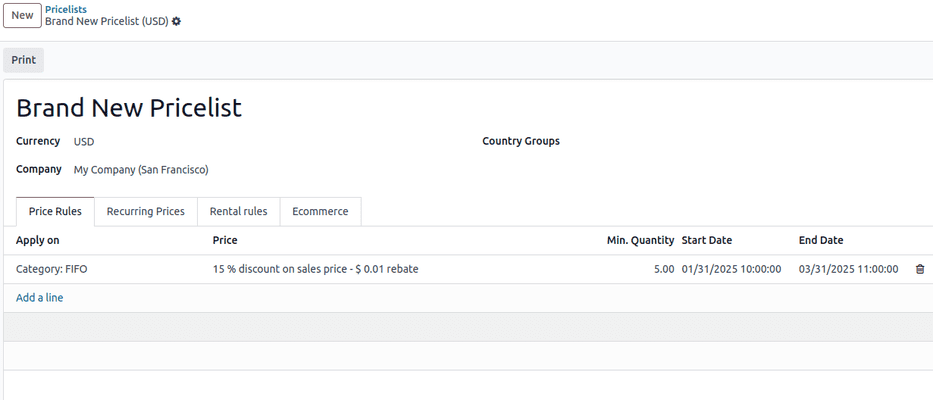
Standard Odoo pricelists can express documented price rules. They do not, by themselves, establish every manufacturer rebate, credit approval or channel incentive your business may operate.
| Requirement | Starting approach | Scope boundary |
|---|---|---|
| Dealer or customer price groups | Sales pricelists and agreed customer assignment. | Test priority, validity and manual overrides. |
| Quantity-based commercial offers | Applicable price rules and quotation quantities. | Check units, thresholds and rounding with a sample order. |
| Supplier or manufacturer rebates | A defined settlement and reporting requirement. | Do not assume a generic discount equals a rebate accrual workflow. |
| Credit and overdue-account controls | Finance review and the required approval procedure. | Verify the exact enforcement point and permissions. |
Receive the shipment as it arrived, then explain its cost.
A receipt should record actual quantities and the required serials, including damaged units and shortages. The purchasing team needs visibility when a supplier order remains open after a partial delivery. The finance team needs evidence for differences between the purchase order, receipt and vendor bill.
For imported stock, Odoo’s landed-cost process can allocate eligible additional costs when its valuation prerequisites are satisfied. Your accountant should determine which charges are capitalized and how they are allocated. Test a shipment where freight is billed later and some goods have already been sold. Specialist customs, trade-finance or import-document workflows are scoped separately from inventory valuation.
Odoo documentation · CC BY-SA 4.0 · CC BY-SA 4.0
Original documentation image, shown without altering the interface. The screenshot illustrates standard Odoo, not a customer implementation.
Connect allocation to the warehouse release.
The warehouse should receive an actionable picking task, not an informal request to send whichever devices appear available. Define whether the operation uses one-step delivery or additional picking and packing steps. The chosen process should match the physical checks your team performs, including serial capture and confirmation of partial quantities.
For several branches or warehouses, test an internal transfer and a customer delivery as different operations. A dealer collecting from another location should not cause an unexplained adjustment at the original warehouse. Establish who can change reservations and what happens when the expected device cannot be found during picking.
Keep the dealer return and supplier recovery connected.
A distributor may accept a returned device, inspect it, exchange it for a dealer and later recover value from a supplier. These are separate commercial and stock events. Agree the evidence needed at intake: original sale, serial number, fault, condition and accessories. The inspection result should determine the disposition of the physical unit.
Serial traceability supports the investigation, but it does not calculate warranty entitlement or guarantee a manufacturer accepts a claim. A return-material authorization process, manufacturer portal integration, warranty reserve or replacement approval may need additional applications or custom work. Map who owns each stage and demonstrate an accepted claim as well as a rejected one.
Electronics wholesalers and computer wholesalers: shared foundation, distinct checks.
Both models can use the same sales, purchasing and inventory foundation, but their catalogue and after-sales rules should remain visible in discovery.
- Electronics wholesalers: distinguish consumer models, regional specifications, bundled accessories and any serial-level traceability required by suppliers.
- Computer wholesalers: preserve exact processor, memory, storage, form factor and regional keyboard or power specifications where these define a sellable configuration.
- For either model, distinguish a manufacturer-provided bundle from an assembly performed by your own business; the latter may introduce Manufacturing or a separately scoped service process.
- If dealers submit files or use a portal, define product references, order acknowledgement, duplicate prevention and error handling before promising automated order entry.
Set currency, branch and responsibility rules before importing balances.
For an Iraq distributor purchasing in foreign currencies, finance should approve the company currency, active transaction currencies, rate maintenance and reconciliation procedure. Supplier bills, dealer invoices and collections on different dates make a useful acceptance scenario. Standard multi-currency functionality does not establish every local statutory report or payment integration.
Clarify which locations are warehouses, which are operating branches and which belong to separate legal entities. That decision influences access and accounting as well as stock. Prepare role-specific training for purchasing, sales, warehouse and finance; each team should understand the exception that it owns rather than only the screen it normally opens.
Prove the distribution cycle with a small, difficult sample.
A useful pilot contains real operating patterns without exposing customer data on a public demonstration. Use anonymized samples and expected outcomes agreed by the business.
- Clean product and partner references, dealer price assignments, supplier codes and opening serial lists.
- Load a small set of open dealer orders, supplier orders, stock and receivables with a documented cutover date.
- Test a short supplier receipt, allocation across two dealers, a split delivery and an internal transfer.
- Test a returned serial, an exchange, the associated credit decision and a supplier claim handoff.
- Reconcile stock valuation, outstanding documents and balances before approving the wider migration.
Make the implementation scope explicit.
A bounded distributor implementation may start with Sales, Purchase, Inventory and Accounting. CRM, Helpdesk, Website or Manufacturing should be added only when they serve a defined process. A long app list does not resolve unclear data ownership or a manufacturer integration with no available interface.
Bring a dealer quotation, supplier order, price-list example and return scenario to the assessment. Ever Digital can use those examples to define the standard configuration, optional extensions, migration effort and acceptance plan. Current package inclusions remain on the package pages; complex distribution rules and integrations are assessed against their own scope.
Questions businesses ask
Can different dealers have different prices?
Odoo Sales supports pricelists. The implementation should test the applicable rules, quantities, dates, currencies and manual overrides. Manufacturer incentives and retrospective rebate settlements are separate requirements.
Can we track the devices delivered to each dealer?
Serial-number tracking can link individual devices to stock movements. The receipt and delivery processes must capture the correct serials, and access to the resulting traceability records should be part of training.
Does Odoo include a manufacturer warranty portal?
Not as a general promise. Manufacturer systems, interfaces and approval rules vary. We assess the required connection and claim workflow separately; standard serial tracking is useful evidence but does not establish entitlement.
Can the system allocate limited stock across dealers automatically?
Odoo provides reservation and stock-management capabilities. Your allocation priorities, credit restrictions and approval rules must be defined and tested. A custom allocation policy may require more than standard configuration.
Can computer wholesalers use the same setup?
The commercial and stock foundation is similar, but computer configurations require precise product identity and may include regional specifications or assembly. We distinguish purchased finished configurations from systems assembled by your business.
What is the best first migration sample?
Choose a few models with serials, two dealer pricing arrangements, an open supplier shipment, a split delivery and a return. Reconcile those records with stock and finance before importing the full operational opening position.
Sources and factual scope
Capabilities checked against official Odoo documentation. These are planning examples, not promises that every feature is included in a Starter package.
- Odoo: sales pricelists
- Odoo: serial-number tracking
- Odoo: forecasted stock
- Odoo: landed costs
- Odoo: returns and refunds
- Odoo: companies and branches
Reviewed:
Ever Digital
Bring your real workflow to the conversation.
Tell us how you sell, stock, deliver or service. We will identify the standard apps, decisions and any extensions your implementation needs.
View Starter packages Current implementation fees and included scope are maintained on the Starter package pages. Odoo licences, hosting and custom work are separate.